BILLY JUMP (he / she / they) is an artist collective, exploring transdisciplinary practices and artistic research in performance art. They were founded in 2023 by Clio Van Aerde, Maja von Kriegstein and Karolina Rupp and are based in Luxembourg (LU), Berlin (DE) and The Hague (NL).
Billy Jump is a fictitious alter ego of its co-founders: cheeky, boisterous, curious, wise, ecologically conscious and in love with reclaiming self care practices. She is spontaneous while being prepared, and fluidly moves between experimentation, improvisation and expanded composition. Billy Jump is attentive, poetic and pragmatic and moves about by bicycle.
Members:
Clio Van Aerde / https://cliovanaerde.com / Instagram: @earthly_clio
Maja von Kriegstein / https://majavonkriegstein.eu / https://www.udk-berlin.de/person/maja-kriegstein / Instagram: @majavonkriegstein
Karolina Rupp
Artist Statement
Billy Jump’s artistic practice finds form in performance, installation, intervention, score writing and publication. They work with ecofeminist, site- and project-specific methodologies focusing on socially engaged, transdisciplinary and collective approaches.
He aims to disrupt the individualistic paradigm of (art) production through insisting on the potentiality of collective making under fair conditions. Moreover, her concern is the de-privileging and reclaiming of self care as social and collective praxis.
Billy Jump is inspired by the connective properties of water, its omnipresence, diversity of scales and local and global tension. Currently, they are researching water in domestic and urban space and the subsequent absurdity resulting from habitual ’civilised’ usage, for example, the flushing of toilets with drinking water.
Project: Billy Jump as guest collaborator at the Free Improv Orchestra hosted by UDK’s Studium Generale (Berlin, June 2026)
How can free expression and moving forward together as a group can become one thing? In times of parallel public spheres, political radicalization and the hollowing out of democracy, the Free Improv Orchestra tries to make a contribution to the work against that dynamic. As a temporary, quite diverse ensemble, they test and further develop an entire toolbox of improvisational performance practices that might be helpful in working towards more permeable structures within the diverse body of a society. We take off from sound related practices, but will not stay there, aiming for a politically engaged notion of improvisation, as a training for collective action facing an unforseeable and in many senses quite worrying future.
The focus of this semester is score writing. We will deal with the relationship between written performance instructions and free improvisation. The first weeks are dedicated to working on historical and contemporary milestones of the score-writing tradition: Cornelius Cardew (ed.), Scratch Music; The Fluxus Performance Workbook; Yoko Ono, Grapefruit; the London Improvisers Orchestra; the Berlin Improvisers Orchestra; Giant Owl Research Center; Andrew Walshe, and many others. This phase concludes with a weekend block at the Sommerbad Kreuzberg “Prinzenbad,” featuring the Waterborne Scores by the artists’ collective Billy Jump (2025) of which two members will also be present. In the second part of the semester, students will develop their own scores and create a final performance.
Project: Waterborne scores: Residency at Bridderhaus (Esch-sur-Alzette, Jul/Aug 2025)
We explored local water industries through score and performance making, launching our first publication with written scores and instructions in combination with movement, sound, sculptural and performative engagements with Riso as both material and technology.
Publication Launch, 2025, Bridderhaus (Esch-sur-Alzette, Luxembourg)
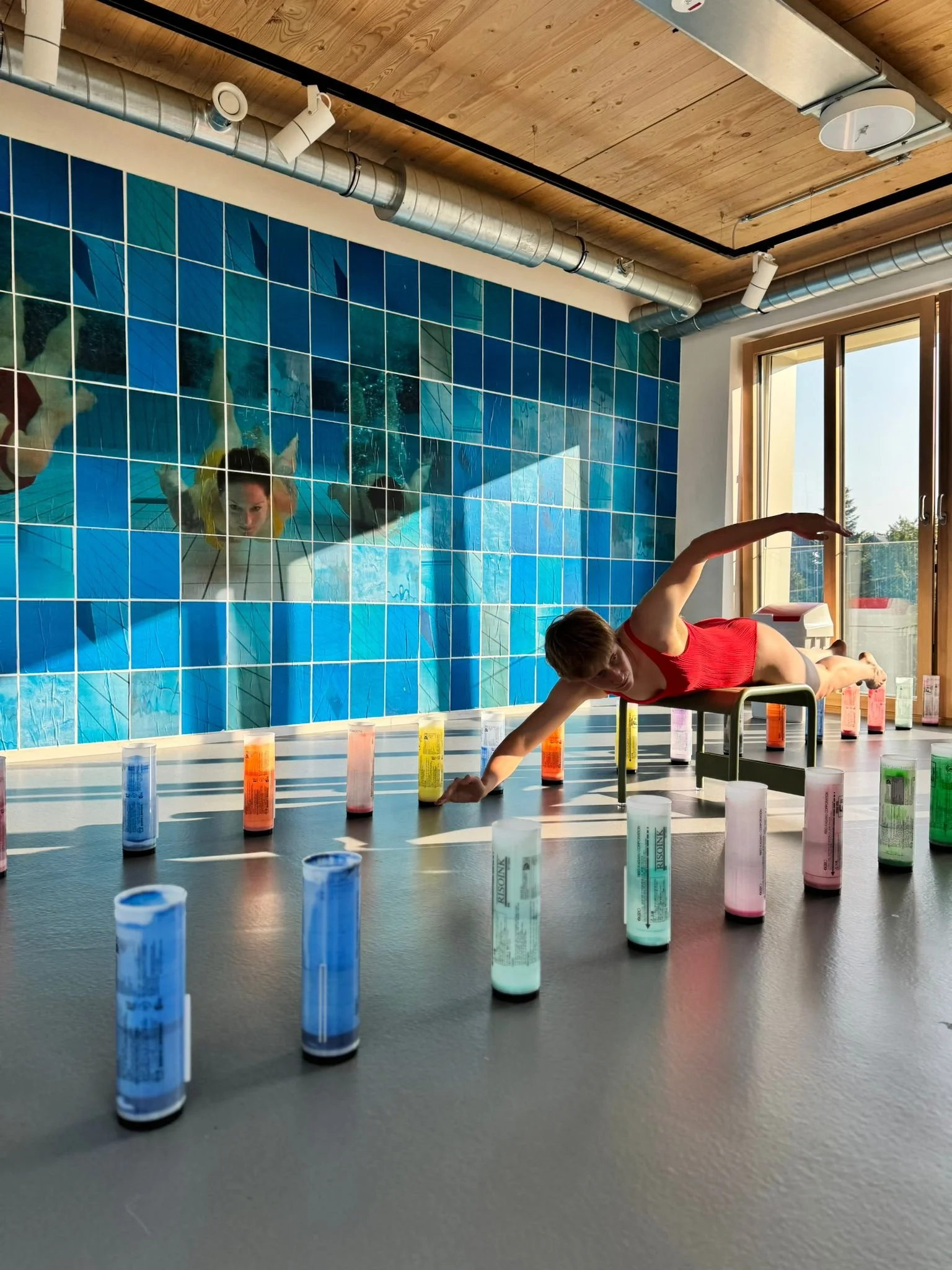
The event unfolded as a hybrid of installation, performance, and publication launch. Entering the space, the audience encountered a wall covered in a tile-like pattern inspired by swimming pool walls and floor. This backdrop combined underwater photographs of the three artists swimming directly toward the viewer with abstract images of the titling used in the local pool. In the same space, two rows of empty risograph cartridges stood upright, filled with water; when peering inside each one, the audience discovered cut-out underwater photographs showing body parts and gestures of the artists. Three dustbins functioned as improvised springboards. A stack of theoretical and historical books relating to score-making, embodied research and ecofeminism was placed on the heater in the space.
Extending the installation beyond the interior, the outside deck featured a flag depicting the three artists’ bodies in swimsuits. Its pole was constructed from water pipes, and a small tap was installed at the top.
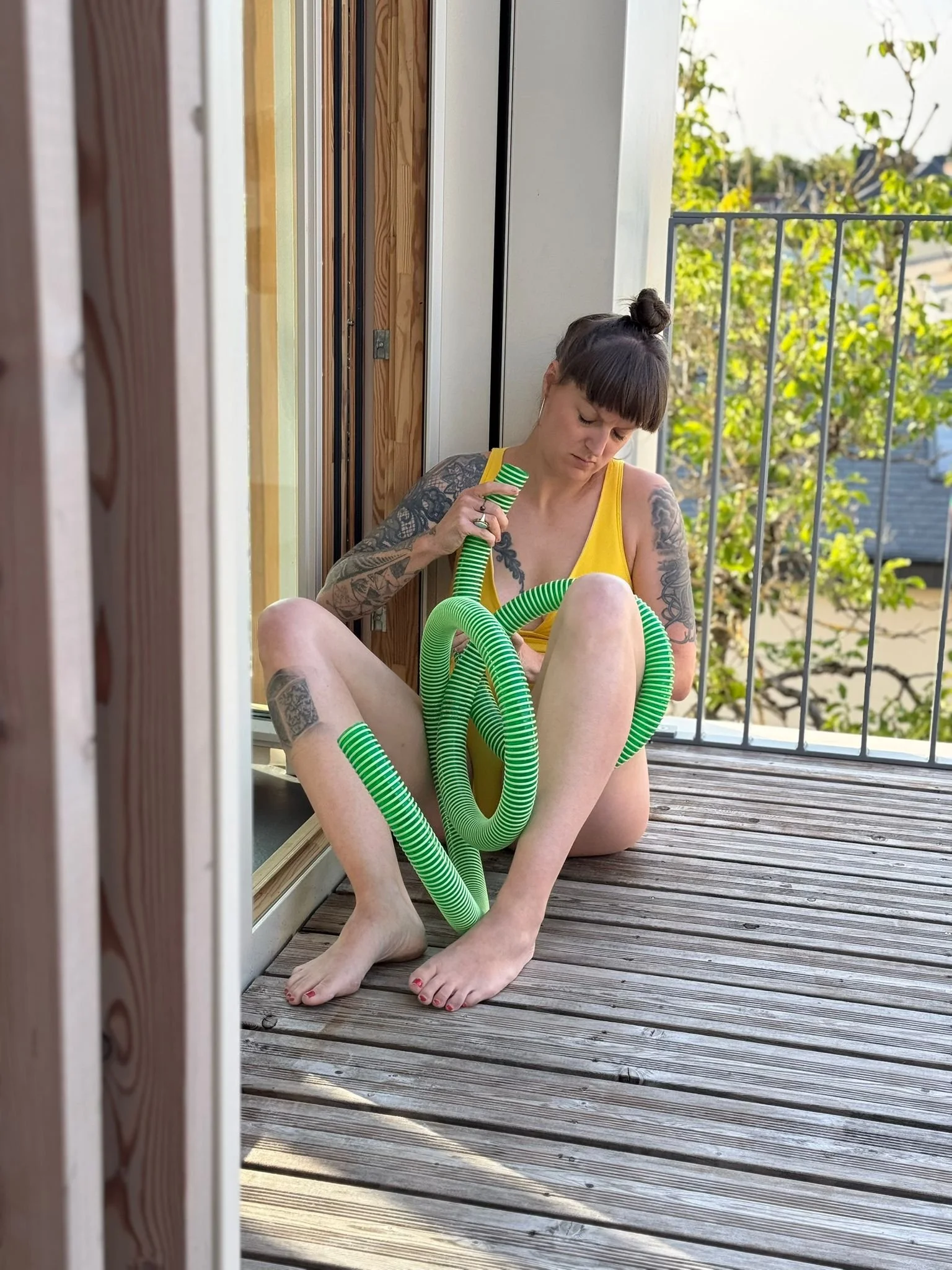
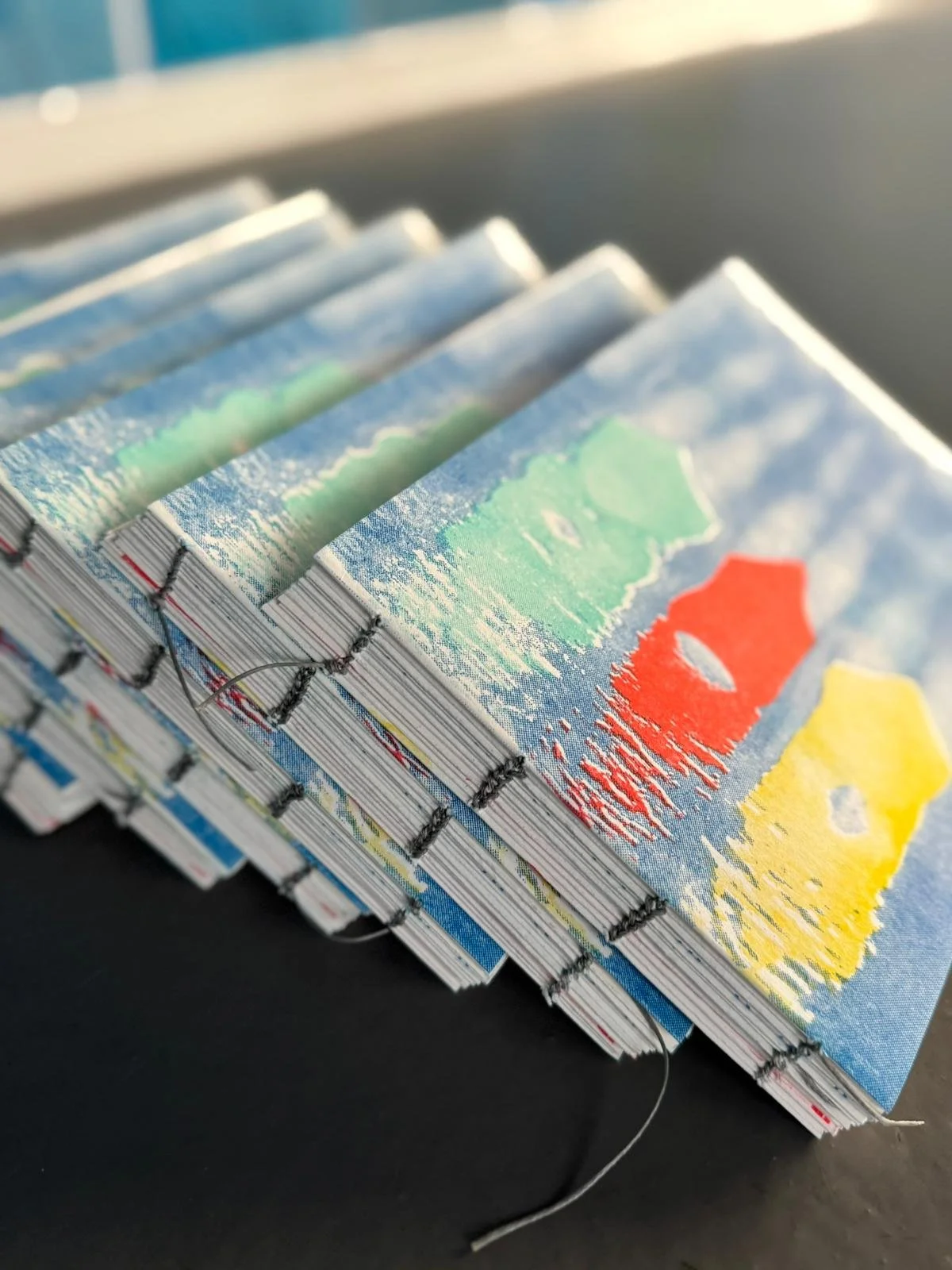
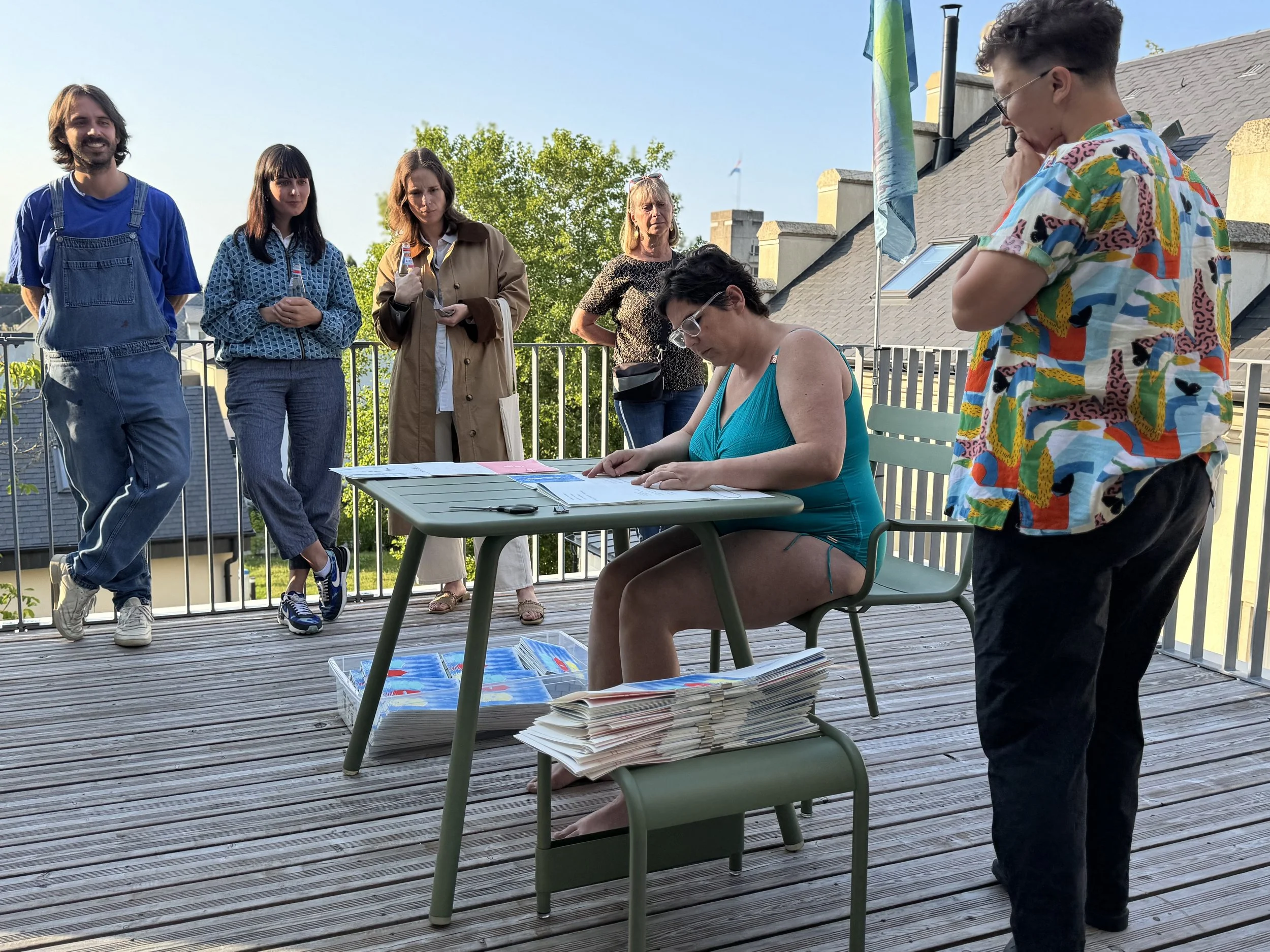
The performance began with the audience circulating among three simultaneous activities. Clio performed “dry swimming” on a stool against the tiled wall, practicing strokes as though in one of the pool’s lanes. Karolina, situated in the transitional space between the imagined pool and the outer deck, responded to a pool-cleaning pipe that resembled the colours of the local pool‘s slide. At the same time, Maja sat outside at a table binding the final copies of the publication produced during the residency. Over the course of the residency, around 120 risograph-printed publications titled Water had been folded and bound with support from the Bridderhaus staff. The publication contains performance scores that we developed during our residency in Luxembourg.
After roughly ten minutes, a Bridderhaus staff member entered the space placing glasses of water next to the artists, marking the conclusion of the performance. The three came together, introduced the work, and shared background on their research before inviting the audience to join them in drinking a glass of water together.
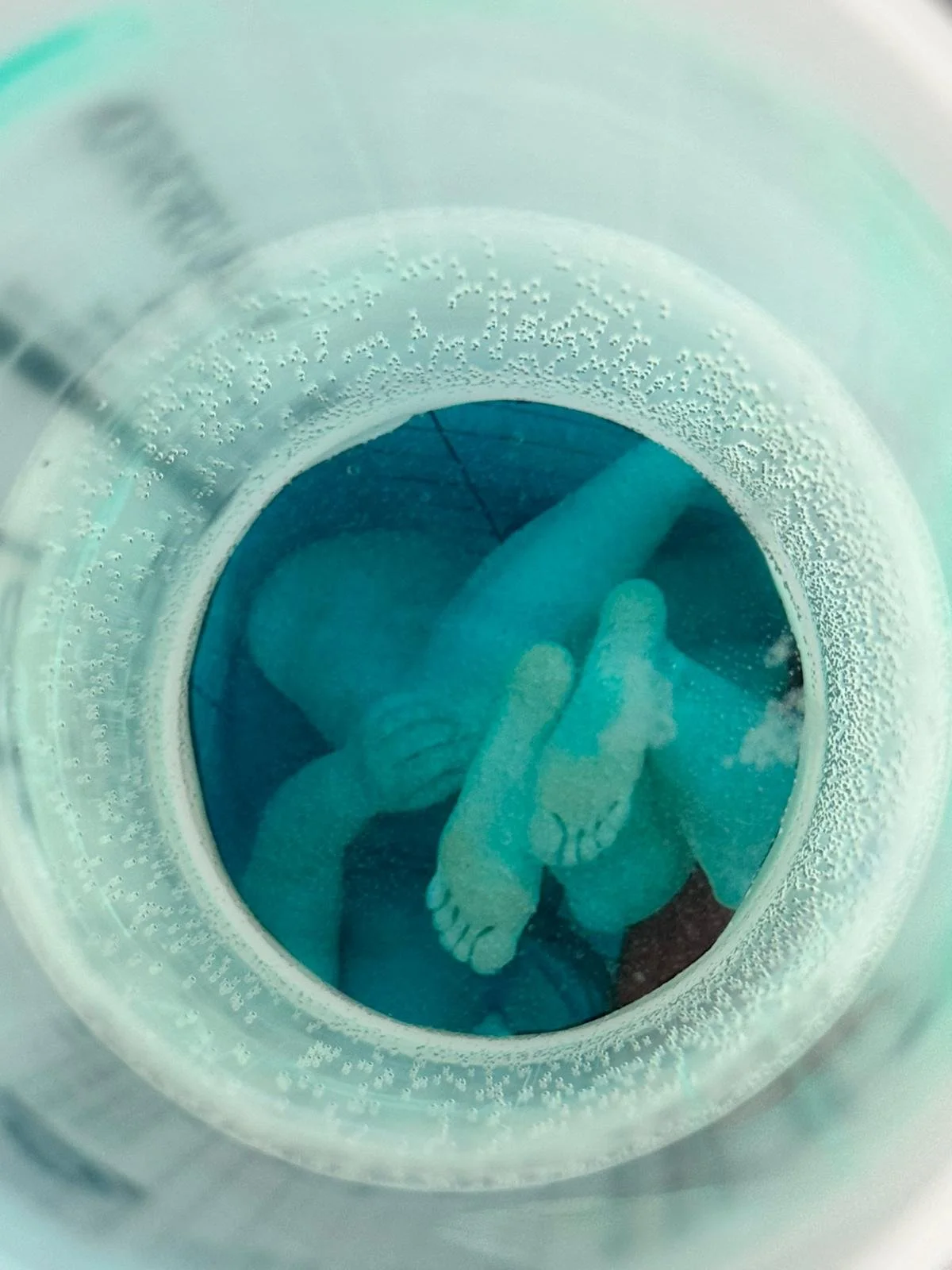
Documentation by Valerie Tholl and Vicky Stoll.
Project: Berlin Residency Acker Stadt Palast (December, 2023)
We initially came together in Berlin to research and experiment on the theme of water, which culminated in an open studio performance. Our work involved collecting water samples from various sources in Berlin, consulting with a local expert, and documenting our impressions of the city's water bodies. We also explored the history of water's introduction into homes and translated this knowledge into a (lecture) performance at Acker Stadt Palast.
Open Studio, 2023, Acker Stadt Palast (Berlin, Germany)
The performance began with the audience being offered a cup of warm water and then invited to take their seats facing the doors present next to the stage area. Once everyone was settled, these doors were opened to reveal a courtyard and the sound of water dripping filled the space as it had rained. The cold winter air created a contrast between the indoor and outdoor environments, adding to the sensory experience. This moment served as a grounding starting point, encouraging everyone to listen, settle in, and become attuned to the space and its surroundings.
In the next section, the performers demonstrated ‘dry swimming’ for about a minute, mimicking the motions of swimming without water on bar stools. After this brief demonstration, the audience was invited to join in.
The next station featured a conversation between the performers and audience. This dialogue focused on the theoretical knowledge gained during the performers’ research, blending reflections on emotions, discoveries, and ongoing inquiries. The conversation was amplified by a unique sound device— a microphone connected to a bucket on an amplifier, which distorted and emphasised the voices of those speaking.
Following this, the performers gathered red-colored items from around the space and backstage, assembling them into an installation while a kettle on a stove slowly came to a boil, its whistle adding an auditory layer to the scene. The performers wore red gloves, repeatedly dunking them in water before handling the red objects. These wet gloves were later hung on a mic stand to drip and dry, contributing to the visual, haptic and sonic texture of the performance.
The performance space was further enriched by an installation of blue and brown prints created by the collective, displayed on a wall. The entrance was marked with a bicycle lane pattern. Also, a small table held a display of water samples that had been collected during the research phase.

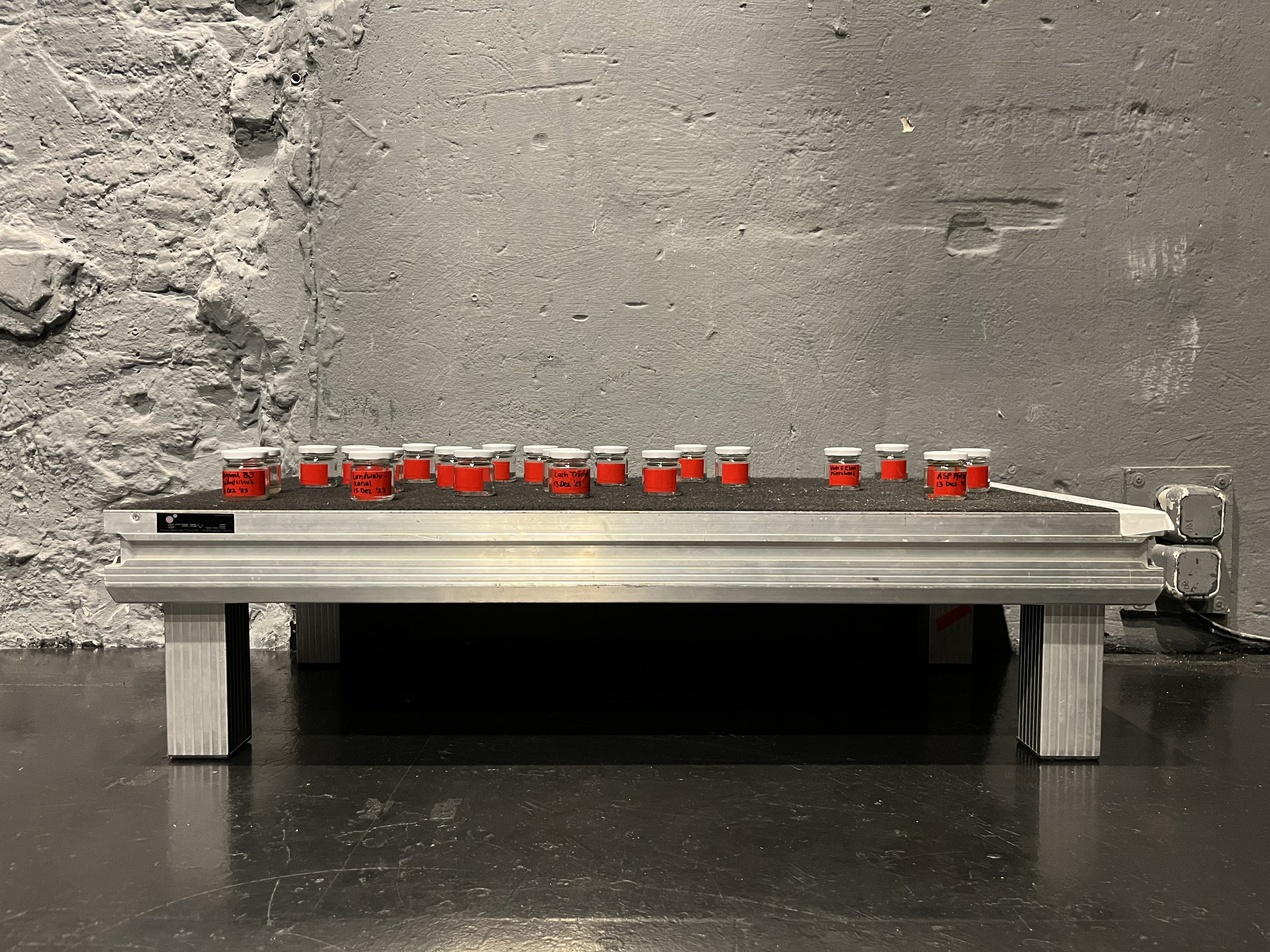
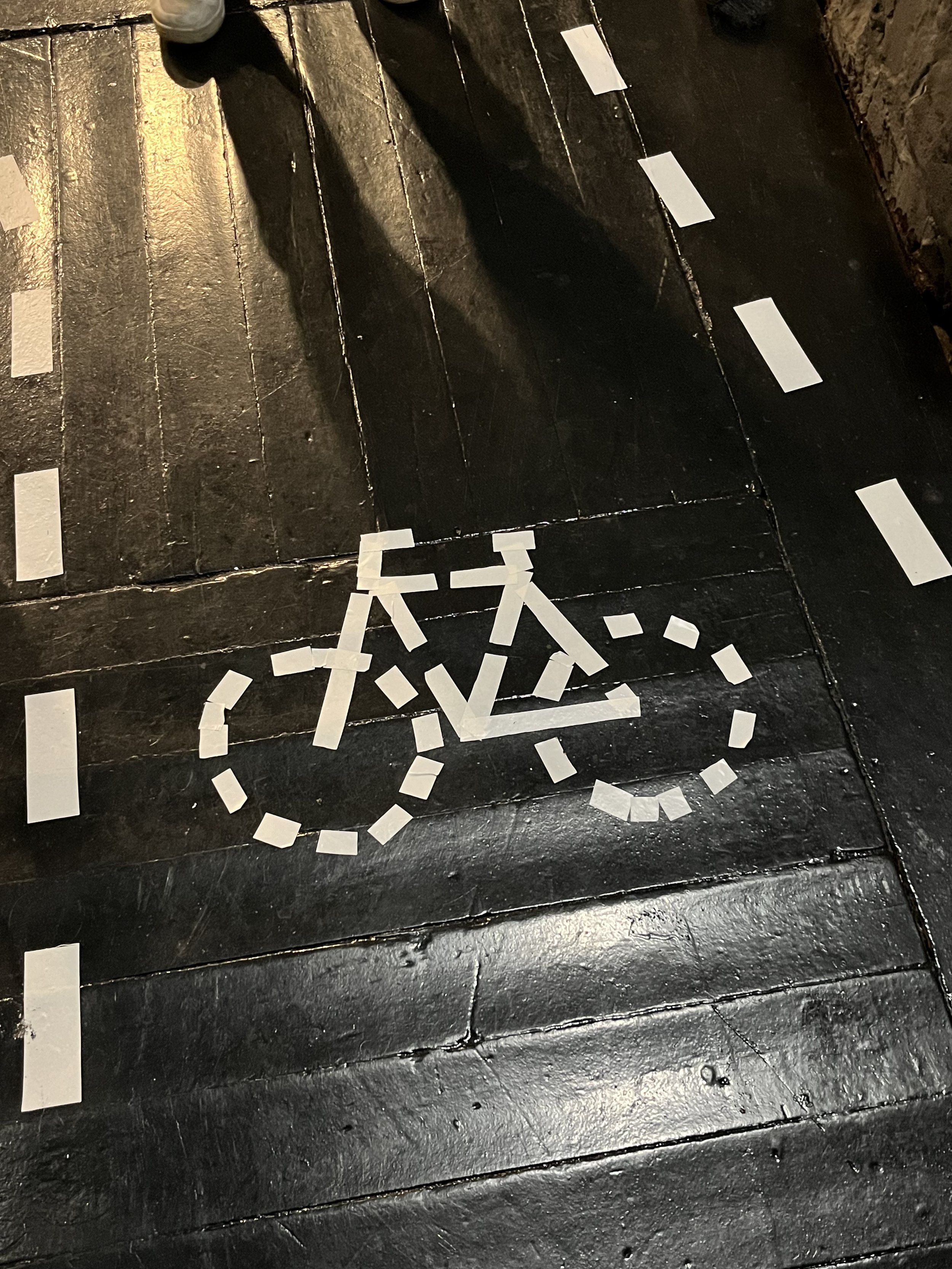
Documentation by Anton Vasilyev.